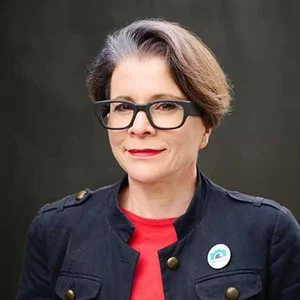
Dawn Eagleton: Capturing Authentic Street Portraits with Confidence
You can also watch this episode on YouTube by clicking on the graphic below.
In this episode of the SheClicks Women in Photography Podcast, Angela Nicholson chats with British street photographer Dawn Eagleton, whose striking portraits of strangers capture real, candid moments with extraordinary authenticity. Known for her bold yet respectful approach, Dawn discusses how she finds confidence in photographing people as they are - without staging, prompting or asking permission.
Listen to another episode of the SheClicks Women in Photography Podcast
Dawn’s journey into photography began in 2016, but it was a spontaneous moment on a family holiday in Valencia that changed everything. Captivated by a stranger in a supermarket, she instinctively took a photograph and discovered a passion for street portraiture that has since shaped her creative identity. She talks openly about how fear and discomfort were part of the early process - and how she gradually found confidence by trusting her instincts and being open with the people she photographs.
Find out who is coming on the podcast and send your question(s)
A key theme of the episode is authenticity, not only in Dawn’s photography but in her interactions on the street. She shares how she captures eye contact without losing the candid quality of the moment, and why those fleeting, unposed expressions have such emotional power. Her method relies on presence and empathy, reading body language carefully and never hiding the fact that she's taken a photograph.
Dawn also opens up about producing her first book, Through the Glass, a curated collection of portraits taken through windows. The series began as a practical way to build confidence and evolved into a distinctive body of work that resonates with people around the world. She explains how she curated the images, learned to navigate the printing process and what she’s proud of now that the book is out in the world.
Throughout the conversation, Dawn gives thoughtful, down-to-earth advice for anyone interested in street photography or looking to build courage behind the lens. She encourages photographers to stop worrying about objections and instead focus on connection - a smile, a nod, a moment of genuine recognition. Her approach is empowering and refreshingly honest, proving that confidence can be built with time, intention and practice.
Whether you're just starting out or already exploring street portraiture, this episode offers inspiration, reassurance and valuable tips to help you approach people with kindness and photograph them with honesty. Dawn’s reflections are a reminder that photography isn’t just about technique, it’s about being present, paying attention and valuing people’s stories.
Connect with Dawn
Fujifilm
This podcast is supported by Fujifilm, one of the best-known photography brands in the world. Fujifilm’s award-winning X Series and GFX system cameras and lenses are suitable for all types of photographers and videographers. Each has been developed utilising the experience gained from more than 90 years in the industry, featuring unique film simulation modes that everyone knows and loves.
Episode Transcript
Dawn (00:00)
I don't explicitly ask people for their permission. The way that I think I get permission is by having that interaction with somebody and not hiding from the fact that I've taken their photograph. You know, I'll never leave a scene if there's an opportunity to
either get eye contact, nod, smile, indicate that I've taken their photo, I will take it, I will always take it.
Angela (00:26)
Hello and welcome to the SheClicks Women in Photography Podcast. I'm Angela Nicholson and I'm the founder of SheClicks, which is a community for female photographers. In these podcasts, I speak to women in the photographic industry to hear about their experiences, what drives them and how they got to where they are now.
Angela (00:41)
Today I'm speaking with Dawn Eagleton, a British street photographer who focuses on capturing candid, unposed portraits. Her main goal is to reveal the beauty in humans in their natural state as they go about their day-to-day life.
Angela (00:53)
Hi, Dawn. Thank you so much for joining me on the Podcast today. I'm really excited to be chatting with you.
Dawn (00:58)
Thank you so much for having me, I'm really excited to be here.
Angela (01:01)
that's great. Well, you're very welcome. Now, one of the most frequent comments I hear from SheClickers is that street photography and street portraiture in particular puts them right out of their comfort zone. So what is it that you love about it and how would you persuade them that they should love it too?
Dawn (01:19)
Yeah, that is definitely something I hear all the time whenever I come across people who've seen my work. The main question I get asked is, you know, how do you find the confidence to approach people? Because my style is that I like to photograph people without permission. So it's quite scary going up to somebody knowing that they are going to see you. And in the beginning, I would definitely
As soon as somebody spotted me, I would panic and quickly, you know, my camera would come down and I would walk away or I would pretend that I wasn't actually photographing them. But as the years have passed, I've realised that actually to just hold your nerve a couple of seconds longer doesn't make any difference. They've seen you anyway. And I find success in being open about the fact that I'm photographing people. Although I don't ask permission.
I'm actually quite interactive out on the street. So it's just those first few seconds where I really want that authentic, raw portrait of someone that are really important to get that. But after that, you know, I will interact, whether that be a smile or a nod. And actually, I conversate a lot more these days as well. But sort of going back to the question, it's it's practice more than anything and it's realising
and being out there, realising that people are actually okay if you deal with it in the right way, if you are respectful and friendly, actually you don't get the objection that a lot of people talk about. You know, this is overriding conversation about street photography. People must object and they really don't. So that was my, my initial thing was...
you know, people will object and that's where the fear comes from but as soon as you realise that that objection actually isn't there and if it is you can deal with it in a very easy way you know that falls to the side, that fear all you're then focusing on is getting the best portrait shot that you can get.
Angela (03:22)
Yeah, I guess if somebody looks up and they see you and you put your camera down really quickly, you look a bit more furtive than if you sort of take a few more seconds and then give them a smile or a nod or a thumbs up or something like that. They know that you haven't been doing anything a bit weird. You've just been taking their photo.
Dawn (03:40)
Yeah, and that's exactly right. find that myself, I know everybody deals with it differently. I've got friends, street photographers that do still adopt that approach where they really don't want the person to know they've taken their photographs. They're in and out and they're gone. But I actually really enjoy that interaction. I get a lot from that and I want the interaction to be positive for everybody, know, myself, the person. And if they ever come across these photographs, which people have started to do, you know, with the...
with the magic of social media. I want them to like the photograph but also I want them to remember it as having been ⁓ a nice positive moment. You know, and I wasn't trying to take something from them. So yeah, find personally that I've had much more success in just being open about the fact that that's what I'm doing and that I've really got nothing to hide. I'm just trying to create some nice art, really.
Angela (04:18)
Yeah.
I think street portraiture or street photography where you have eye contact with the subject, it is much more engaging than photographs snapped with a longer lens or from further away or side on or from behind and stuff like that. How long do you normally, are you prepared to wait for someone to actually look up?
Dawn (04:55)
I think it depends how good I think the photograph is going to be, guess, is the answer to that. you can't, you know, sometimes you're at a point where...
You just know, you feel that it's too long. You can't encroach on someone and, you know, stand there forever and ever and ever and wait for them to look up because it's just not fair and it becomes a bit sort of awkward, I guess. Everybody else around starts noticing you.
Angela (05:08)
Yeah.
So, yes, everyone's
looking at you wondering why this person's not looking.
Dawn (05:23)
Yeah,
but I do enjoy the eye contact. think very early on I realised that that was a very, very good point of contact for the viewer of the photograph, you know, for them to be able to have that eye contact, somebody looking back at them. It's, I'm trying to sort of create these sort of reflections for people. You know, I really want the viewer to relate to the subject that I'm photographing and the eye contact allows me to do that.
But I do also really, really enjoy these kind of pensive shots as well of people, you know, looking thoughtful. So both to me, I enjoy both, but the eye contact, I think, when I first realised that I enjoyed that, I had to work out a way of getting the eye contact, but still maintaining it as a candid portrait. Because what I don't want to do is I don't want somebody to
Angela (06:13)
Mm-hmm.
Dawn (06:17)
see me and then change their demeanour. You know, that's exactly what I'm trying to avoid. I'm trying to still maintain or retain that authentic, you know, either gesture, expression, mannerism, posture, all of that. I'm trying to get the essence of them. And as we know, if someone sees a camera, normally their demeanour will change. So with the eye contact, I worked out that there was this really, really small window of time.
that I had to get the eye contact whilst they were still in this kind of natural state. And that is the first moment that they look up to see what I'm doing stood in front of them. So they're consciously aware that I'm there, but not consciously aware that I'm about to take the photo. And it's, as I say, it's a very small shake of time that I'm looking for. I don't always get that. You sometimes you'll notice in my photographs that people are smiling and obviously that is a reaction to me.
But a lot of the time I like to adopt that technique of getting myself ready before I approach so that when they look up to see what I'm doing walking towards them, that's the minute I get the photograph.
Angela (07:28)
But a smile in that instance is an instantaneous, spontaneous result of you being there, isn't it? It's not a posed shot, it's not them preparing and sort of having that fixed grin while you compose the shot. So it's natural.
Dawn (07:39)
Yeah,
it's a natural reaction, I guess you could say, which is one step beyond the portraits I take that are really of somebody with their natural demeanour. And a lot of people do comment on the fact that some of my photographs, the people in them, they do look quite miserable and people question whether it's because they're upset that I'm taking the photograph. But actually it's a result of me.
adopting this technique where I am capturing people as they are. And if you just look around when you're on public transport at people who aren't communicating with anyone else and they're just in their natural state, we've all got a kind of neutral, sort of miserable face. We're not all sat there sort of smiling, are we? Unless we're, you know, lost in thought and thinking about something funny. But most of us, when we're in our natural state, we have quite miserable looking faces, I think.
Angela (08:19)
Yeah.
Yeah.
Dawn (08:32)
⁓ And so that's the answer to that. It's not that these people have been upset by me. It's just that that is how their expression is at that moment.
Angela (08:42)
Do you tend to have your, do you look through the viewfinder and have your camera to your eye or do you use the screen on the back of the camera so the camera is lower down?
Dawn (08:50)
You know, it's funny, I hadn't actually really thought about this in great detail until somebody asked me years ago when I was videoed out and about on the street. And I do both actually, it depends on what the situation needs. I'm not a shoot from the hip person, if that's what you're asking, and I don't sort of twist the screen and look down. I'm either like this or, you know.
to my eye, but it all depends on what I feel that that situation needs at the time. And it is instinctive actually. And this is why I hadn't really, when somebody asked me, I was like, I don't actually know how I took that shot. It was just kind of instinctive. I guess I look through the viewfinder more if I feel that it really needs me to sort of hone in on some kind of composition. know, sometimes there isn't time for that. You've just, you know, you've got to go, you've just got to go.
The moment's there.
Angela (09:42)
Yeah, the reason I asked that actually was because I was thinking if you have the camera lower down, slightly below your face, when the person looks up, they naturally look to your face and then they're going to spot the camera afterwards. Whereas if they look up and you've got the camera to your eye, they will see both in the same instant.
Dawn (09:58)
Yeah, that's a really good point, actually. But either way, the moment I'm clicking it, you know, they've not realised, you know, they've only realised in that second. Yeah.
Angela (10:06)
Yeah, because you're so quick. Yeah.
what first got you into street photography?
Dawn (10:13)
Well, I bought a camera. I mean, there's a long winded answer to this, but the short answer is I bought a camera in 2016. It was the Fujifilm XT1. I didn't really know a lot about these sort of semi pro cameras at the time. I walked into a shop and I said to the lady, you know, I'm quite interested in buying something that's going to give me some decent photos. And she was, you know, she was raving about this Fujifilm. So I went with it. I knew I was interested in portraiture.
I didn't really know what I wanted to do at the time. I had a full-time job. I was an estate agent for many years. And so I began sort of taking photographs of my family and my dog and you know all the things that we do when we're trying to sort of work out what are we actually interested in as photographers. And then it wasn't until 2018 when I was in Valencia on holiday with my family and I was...
walking around the streets with my camera because I was taking pictures of my daughter who was quite young at the time. And I remember it had been going through my head, you know, how can I try and practice portraiture without keep relying on taking pictures of my family? Because I'm sure that gets annoying, doesn't it, for families and friends. And I started to realise, well, you know, there's people everywhere. And this gentleman walked past me in the supermarket on my last day.
Angela (11:21)
Hahaha.
Dawn (11:31)
and I was just fascinated by him. He just looked like he had an incredible life story to tell. And just to give you a bit background about me, I'm interested in human behaviour and my degree was in film and communication. you know, I'm interested in visuals, but I'm equally interested in human behaviour. So I'm always thinking, you know, what's their story? What's their story? And because I had my camera in my hand, it just dawned on me that actually
I could take a portrait of this man and hopefully that image would relay exactly what I thought in that moment, that his face kind of told this story. And so I followed him out the supermarket and luckily for me he waited for incoming traffic and he looked back just as I was holding my camera and I clicked the shutter. And to be honest with you, I really thought that he was going to object or to say something or, you know,
what are you doing? And he didn't. He just looked at me and went on with his day. And it was just one of these sliding doors moments, I call it now, because it was that first realisation that this is actually what I'm really interested in. You know, I'm really interested in people and I'm really interested in the authenticity of somebody. And so I went home to Exeter, where I lived at the time, and I just began taking my camera out on the street.
Angela (12:33)
Yeah.
Dawn (12:49)
and I didn't really know anything about street photography at that time either. So I was in this sort of almost privileged position where I could just follow my instincts without having too much of outside influence on me.
Angela (13:01)
So it must have been a really exciting point for you when you realized it was your thing and started working on it.
Dawn (13:06)
Yeah,
I think you are very lucky in life if you can really listen to your instincts and say, okay, strip everything away. What is it that I really feel passionate about? And along this journey, people have said to me, know, how are you going to make money out of it? Surely you need to go into commercial photography, wedding photography, this. And it always made my heart sink a little bit because I knew that that was not what my passion was. And I knew that.
maybe it would take away the passion if I felt forced into a corner. Luckily I haven't had that, I haven't had to do that. You know, I've maintained being able to work part-time and do the photography that I want to do. And there is no money in street photography when you first start out. It is all about passion. You really have to just get out there and shoot and shoot and shoot and shoot and shoot, just out of pure passion.
and won.
Angela (13:59)
Yeah. Oh, that's fantastic. I'm really glad to hear that you were able to pursue your passion in that way and just hone your technique and produce such fabulous images. I think if you think about the great photographs in history, a lot of them are documentary or street photography. You know, you think of Cartier-Bresson's moments. And I think it's important to remember when you're worrying about objections that people might have or concerns, you are documenting people in the moment, their everyday lives.
And in the future and now, obviously, it's a really interesting body of work that you're producing.
Dawn (14:34)
Yeah, it's difficult to know what it's going to mean in the future. I think we tend to romanticise the street photography of the 70s and of the 50s because it is of an era that no longer exists. And a lot of street photographers these days, try to emulate that today. They're trying to get a feel for what those street photographers were doing then, which is great because the images are beautiful and nostalgic and vintage.
But it's difficult to say really what these images will mean. But yes, it's often crossed my mind that it's important for me to try to document people as authentically as possible. Because it will mean something in 50 years to see actually how we were living and to realise that people were relatable today as they will be in 50 years. You know, we're all living this shared experience.
and this is what I'm trying to do by documenting real, true expressions. I'm hoping that the viewer of my photograph can really just relate to the subject. But yeah, think I'm not sort of too deep about it. I think that what will be, what will be. And I simply just want to create images that I really like in the here and now. And if in 50 years, it means that somebody can look at a body of work and
it becomes relevant in some way or important to document people in this way, then that's amazing.
Angela (15:56)
Do you think being a woman makes it little bit easier because women are perceived generally as being a bit less threatening?
Dawn (16:01)
I have been asked this many, many times in the last eight years, but I guess yes, if you're talking about women who are approaching members of society in this way, I think yes, you could say that it's easier for a woman because they're less intimidating generally.
But there are certainly situations in street photography where it is easier for a man. I tend to stay away from going out at night on my own, for example. I know male street photographers in London and other cities that have been able to move into areas where they're documenting quite difficult stuff within groups of men, particularly, that I would never be able to.
to go and do. So traditionally speaking, if you're talking about photographing women and children, yeah, I think it probably is slightly easier. It's not easier because it's always, it's still hard, you you still have to find the courage to do that. But I guess subconsciously, there's a layer of you thinking, okay, I can get away with this because I'm less intimidating.
Angela (17:02)
Yeah.
Dawn (17:13)
But it still takes an enormous amount of courage as a woman to do it. I wouldn't say it's easy by any stretch of the imagination.
Angela (17:21)
No, no, I wouldn't either. So how do you actually select your subjects?
Dawn (17:25)
Well, I'm always looking for just some kind of character. And by that, I think people misinterpret me when I say that a lot of the time. They sort of say to me, you should go to this area because there's lots of people dressed in loud clothes and crazy hats. And that's not the sort of character I'm looking for. I'm just looking for this sort of much more nuanced little layer about somebody, some sort of.
Angela (17:42)
Yeah.
Dawn (17:52)
something that's interesting to me. It can be a number of things. It can be a mannerism, know, a little gesture, a posture, just the way they look sort of generally, you know, like the guy in the supermarket in Valencia. He was an older gentleman and I just found him interesting. His face to me told a story, you know, and it's those little details that you can pick up about.
people if you're really looking closely enough and I think in life we tend to just walk past each other don't we and don't really give too much attention.
Angela (18:29)
Yeah.
Do you ever get any reactions that you think ⁓ that's not a photo I'm gonna post anywhere
Dawn (18:37)
Yeah, of course. mean, what I would say to that is I have become very good at knowing whether somebody feels uncomfortable before even I've got to the point. You know, I don't encounter a lot of objection, but I think that it's because I manage not to annoy too many people. I had a situation in London once where I approached a window and there was a
guy in the window sat next to the woman who I wanted to take a photograph of and I could see him just, it was very, very small gesture, but I could see he felt a little bit uncomfortable about my presence and I thought, okay, I'm just going to leave the whole scene. I don't want to ruin his lunch. I was with somebody else who spotted him, thought he was a good opportunity to take a photograph, hadn't picked up on the fact that maybe he felt a little bit uncomfortable and they went in there.
Angela (19:15)
Yeah.
Dawn (19:28)
taking several photographs and he ended up coming out and confronting us and was upset about it. So I avoided that situation just by picking up on that. So I think as a street photographer it's really important that you really are looking at everybody's body language as you're moving around. You can't always get it right. I don't always get it right. You know often I'll get people that say, not often, sometimes I'll get people that say, did you just take my photograph? And I'll say yeah, is that okay?
Angela (19:36)
Mm-hmm.
Dawn (19:55)
And sometimes they say no, and I just apologise, you know, I'll say I'm really sorry I didn't mean to upset you. And that is, as far as it's ever gone with me, I've never had anybody that has been so upset that, you know, I've taken a photograph of them, they hated it, and I've decided I'll post it anyway. There's one that is a very popular photograph of mine that is of a hairdresser, he's doing a lady's hair, and...
she looks shocked, he looks sort of angry at me. But actually the truth of that shot is as soon as they realised that I was unthreatening and what I was doing, they fell about laughing. And so the photograph is a great photograph because it's got some great expressions. But people do often say to me, know, do you think it was right to post it? And so I have to tell the story. have to say, yeah, on this occasion it was because I know the story and actually
his daughter ended up finding it on Instagram. And I printed off a copy and took it down to him into the salon and he had it up in the salon. And he was a lovely guy, so charismatic. And so that was a nice experience, but sometimes the photograph doesn't always, well, never tells the whole story, does it?
Angela (21:07)
Yeah, yeah, no.
Do you ever, does anyone ever ask you to delete a picture and do you delete them?
Dawn (21:13)
I've never ever had that and I'm going to touch wood because now it will probably happen but no genuinely I've never had anybody ask me I've never been in this situation I know I have spoken to street photographers that have had horrible encounters where people have said to them show me your camera and you know delete the pictures but I've never encountered that and as I say I do pick and choose who I photograph I don't just photograph anybody and everybody I will sort of
Angela (21:17)
Yeah.
Dawn (21:42)
And this is all happening in seconds, isn't it? You're sort trying to work out as you're going around. But generally, if I think somebody, doesn't feel quite right, I just, I won't do it. The thing is as well, being a woman, you have to be a bit more careful, I think, in certain situations.
Angela (22:00)
Yeah, yeah, that's true. What is your advice to anyone wishing to give street portraiture a try?
Dawn (22:06)
My advice is really to...
you know, don't worry about objection. You will.
As humans, we all feel that fear, I think. I haven't spoken to a single street photographer that doesn't feel nervous about approaching a stranger and taking their photograph, but you have to push through that. You know, there were times in the first few years where I thought, I'm not really sure if I'm cut out for this because it's hard and I couldn't sort of shake this feeling when I was going out that, you know, it feels uncomfortable and I'm not sure it feels...
Angela (22:31)
Yeah.
Dawn (22:40)
you know, easy enough, why am I putting myself through this? But once you find your rhythm and you realise that actually you're out on the street and you find that confidence, I love it. I love just going out there, capturing these moments and having these interactions. It's great. And you will encounter people that don't want it. And I think the more you do it, the more you go from a place of thinking, I really hope somebody doesn't object today.
and you move into this space where you realise that probably people will object in some kind of way and that it's okay because you can deal with it. And so you're not walking around worried about people saying no, you just think if they say no, I'll just apologise and I'll move on. And once you've got that in the back of your head.
you can concentrate on the important stuff, know, your own body language, picking up on other people's body language and obviously the technical element of taking the photograph as well. The other point about the technical thing is, and somebody took a video of me recently when I was in Tokyo of me approaching someone and I love it when people do that because you don't always see yourself from that perspective and I realised that because I am intent on getting the portrait, I'll walk up to the person and I will
plant my feet in the floor and really have a good steady stance. And I think that's really important to get those really sharp, strong portraits because if you're sort of going in there and you're a little bit worried and you're taking the portrait with one hand because you're a bit scared and you're not really, you're not planting your feet in the ground and being certain that that's what you want to do, you won't ever quite get the shot that you want to get.
Angela (24:13)
Yeah.
Dawn (24:20)
So that is the other piece of advice. Go into these things with purpose and be unapologetic about it. You're creating art and you're there for the right reasons.
Angela (24:32)
Yeah, so put your street photography mask on, you go in pretending you have a confidence that you may not necessarily be feeling.
Dawn (24:40)
I think you'd certainly have to to begin with, know, fake it till you make it. But I, the main thing for me and the words that has come up again and again is authenticity. And I'm looking for authenticity from my photographs, but it means that I also have to be out there and be an authentic myself. I have to be myself. And you'll be surprised when you go out and you're yourself and you let your own guard down.
Angela (24:44)
Ha
Dawn (25:10)
how much you get that back from people. And I think that's a really important point. I think you really have to be revealing of yourself.
Angela (25:20)
Yeah, that's really nice, isn't it? That's the reward in a way to actually, you get a nice photograph that you're very happy with, but then you get to chat with the person or exchange a nod and everybody's, just gained something from the situation.
Dawn (25:33)
Yeah, I think it's not really something I had considered when I started all of this. just want to take nice photos, don't you? And everything that's come from it has been nothing short of surprising. All these lovely things that have come from photography. It's so good for your mental health, but also it was really good for connecting with other people, albeit sometimes just these little tiny moments that you have with other people. But it's all...
It's all really good for you and I hope that it's good for the people that I am interacting with as well.
Angela (26:07)
Yeah, I think so, because you're saying basically they're interesting.
Dawn (26:11)
Yeah, yeah. Sometimes the times I feel bad is if I'm taking a photograph of somebody behind someone and they'll pose for me, the person in front, and I'll say, no, it's not you. And then I think, no, I feel really bad now because I don't want them to think they're not interesting. You everybody's got something about them. It's just they're not always sat in a nice, you know, framed position. Exactly, yeah.
Angela (26:13)
Hahaha
⁓ yeah.
Yeah, yeah.
Yeah, a nice patch of light or something.
Now, you recently published your first book, Through the Glass. How did that come around?
Dawn (26:42)
Well, it was basically born out of my start of this journey. When I went back to Exeter, I was really focusing on finding people that were kind of in these sort of almost isolated situations where they were either, you know, thinking or by themselves pensive, you know, that I was looking for that, these solitary moments, I guess you could say. And
A lot of the time people were actually sat down either on public transport or in cafes and so I was just snapping away and it all of a sudden occurred to me that I was kind of fortuitously collecting this kind of cohesive catalogue of images that were all taken through glass and it was a very organic thing actually. A lot of people came to know me as the person that shoots through glass.
Angela (27:34)
Yeah.
Dawn (27:34)
And
so when I was thinking about my first book, I went back and forth. And I had to do the Through the Grass one as my first book. It's sort of a tribute to everybody that's been with me this whole time that really enjoys that series. I know there's a lot of people that really like that series and I'm so grateful for everybody that's supported me. And so it felt right to do it. And I had a nice...
64 images that I was really happy with that went into the book. There's been several more that have been taken over the years, but those are the ones that I was really happy with. and the book itself, it's a new thing to learn how to do, isn't it? There's so many processes that go into making a book. I'm so pleased that I did it. It took longer than I thought. There were more obstacles than I thought.
Angela (28:05)
Yeah.
Dawn (28:18)
But really I'm just so pleased that it's out there in the world now. My one thought with it was that I wanted to start really putting these collections into print form. I want these years to be documented somewhere, I guess. So just having the book finished and out there is a very nice feeling.
Angela (28:30)
Yeah.
Congratulations. What was the biggest obstacle you faced?
Dawn (28:42)
the biggest, I mean wasn't, there wasn't loads of big obstacles, it was all the little ones, all the little decisions along the way. Yeah, yeah, you know, you think you've made a decision on one thing and then you change your mind and you know, getting them to the, I printing your work I think is a whole other skill.
Angela (28:49)
Right. They just mount up. Yeah.
Dawn (29:04)
learning the processes of, and I wasn't printing them myself, but understanding what changes how an image looks in print. You know, the paper, all the different designs, it's worthy of giving a lot of thought to, and I know people that have produced books have said the same, it's taken them longer because they wanted to get it right. I think when you put something out there, you want it to be...
Angela (29:13)
Mm-hmm.
Dawn (29:33)
You want to be proud of it, you want it to be right.
Angela (29:36)
Overall, would you say you enjoyed the process or was it a slog you were glad to get to the end of and now you've got something fantastic to show people?
Dawn (29:44)
I would say there were moments where I questioned why and what on earth I was up to. But I'm so glad I did it. You learn so much along the way doing these things. I spoke to a street photographer last year who said, do the book before you think you're ready because you learn so much. And I'd really, really waited.
Angela (29:49)
Uh-huh.
Yeah.
Dawn (30:07)
I really waited as long as I could to ensure that I had all of the images. I could have done this book probably a couple of years ago. But then you get another image that you love. Well, that's another one for the book. Maybe I should wait this year because you're growing in skill set as well, aren't you? As the years go past, the images that I took in 2018, 2019, a lot of them made the book.
And they will probably be some of my best images I ever take. But as you grow in skill and in confidence, you sort of start to look back at those and think, gosh, are they good enough? But no, they are, and I'm very proud of them. And I don't think I will ever not continue to look for people through windows. It's just how I'm wired now. But certainly it's nice to wrap up that.
Angela (30:56)
Yeah.
Dawn (31:02)
portion of my journey and you know it did coincide with me moving. The sun's not shining today but I'm now in Ibiza. We moved here this summer and it felt right to kind of not close the chapter because I'm still going to be doing that sort of photography but to sort of a pin in that point.
Angela (31:08)
you
Mm-hmm. And where can people buy the book?
Dawn (31:25)
my website it's dawneagleton.com very easy yeah there's a link there.
Angela (31:29)
Great.
Fantastic. So I think that's a great time to go to six from SheClicks. I've got 10 questions from SheClickers and I would like you to answer six of them please by picking numbers from one to 10. So could I have your first number, please?
Dawn (31:43)
Yep, number four.
Angela (31:46)
What is your favorite technique for capturing people? Do you find a particular spot and stay there or do you wander around? That question's from Yanina.
Dawn (31:55)
I wander. I'm not patient in any way, shape or form. I'm constantly moving when I'm out on the street. I just find I operate best when I'm walking and looking. I really admire people that can stand in one spot. They see an amazing scene and they wait for the person to move into it. I think you get some amazing shots like that. But my brain just doesn't work that way. just, you know...
I've tried it and I'll stand there for about a minute and I'll go, ⁓ no, no, and I'll move on. So yeah, I'm always moving, but I move with intent. You know, I move if I, if it's a kind of cloudy day and I'll see where I'll sort of follow the light or I'll have some kind of idea of the types of locations that I want to go to that will kind of give me the sorts of shots that I'm looking for. So it's not, I don't.
Sometimes I wander aimlessly, but I've usually got some kind of plan.
Angela (32:51)
Okay, can I have your second number please?
Dawn (32:54)
err seven.
Angela (32:56)
Okay, number seven. Have you always used glass as a creative tool or did you start shooting through it as a form of protection? That question is from Marie-Ange.
Dawn (33:07)
That is interesting that you've asked that because when I look back I realised that the glass thing, was a form of protection. Totally was a form of protection. It gives you this physical barrier between yourself and the subject and that was definitely one of the reasons. The other reason I shot through glass was because I found it a lot easier to practise my technique of getting closer to people because they were in a different environment.
Angela (33:14)
Mm-hmm.
Dawn (33:31)
with different sounds and different distractions, I could approach them without them seeing me as easily. It's not as easy when you go up to someone who's stood on the same street as you. And so that was another reason why I was drawn to glass. But during this process, for the reasons I've said I shot glass, I realised that it was a brilliant tool to use in street photography. And so I started using it to create more creative shots, know, the textured stuff.
the sort high contrast stuff. I realised that that tool was amazing, glass was amazing, so yeah.
Angela (34:06)
Great. Okay, can I have your third number, please?
Dawn (34:09)
err number one.
Angela (34:11)
how you captured that person? That question's from Anne.
Dawn (34:19)
No, is the honest answer because I guess the way that I'm trying to capture people is to not to disturb them. My ultimate goal is to capture them as they are without having any kind of influence on them, if I've understood that question correctly. The sorts of portraits I'm taking, they're not really collaborative. I'll find, the simple thing that I do is that I'll see somebody I like the look of and I'll work out the best
Angela (34:38)
Mm-hmm.
Dawn (34:46)
position to stand in. So there'll always be variables that change depending on who they are, what they're doing, how they look and that will mainly be composition. But it's never a sort of collaborative situation.
Angela (35:01)
Okay, right. Could I have your fourth number, please?
Dawn (35:04)
at two.
Angela (35:06)
Number two, do you ever ask for permission to post or publish a photograph? That question is from Liz.
Dawn (35:12)
I haven't and I didn't and if I ever shoot for my own portfolio, no. I mean, what I mean by that is that I don't explicitly ask people for their permission. The way that I think I get permission is by having that interaction with somebody and not hiding from the fact that I've taken their photograph. You know, I'll never leave a scene if there's an opportunity to
either get eye contact, nod, smile, indicate that I've taken their photo, I will take it, I will always take it. So in a way that's a kind of permission in itself that they're fine. When I've done commercial work, so this year I did a campaign for Fujifilm for a new camera, because the images were being used for marketing purposes, I had to get permission.
And I didn't realise that that was the case. they wanted me to... They wanted to film me going about with this brilliant new camera in the way that I always would, with the caveat of me then having to go and get something signed from them to say that it was okay.
Angela (36:20)
Yeah.
Dawn (36:22)
And so I was a little bit nervous, I'll be honest, because it's something I'd never done before. I'd never sort of put a piece of paper and a pen in someone's face and said, please sign this just in case we're going to use it. And I was a little bit nervous, as I say, about that. But as we got going, I couldn't believe how gracious and lovely people were. I'd take the photograph in the way that I took it, but then I would go in to talk to them. Or if they were on the street, I would go over and talk to them and tell them what we were doing.
Angela (36:29)
Yeah.
Dawn (36:49)
and they were so happy to sign but also they were just lovely about it. Every single person I encountered on those couple of days of filming were absolutely brilliant and there was a part of me, I'll be honest, that thought maybe I'm telling myself that people are okay because it suits my own narrative. So being forced into a situation where I physically had to ask people permission and for them to come back and say, yeah, of course, you know, how amazing and...
Angela (36:56)
Yeah.
Mm-hmm.
Dawn (37:17)
being able to show them the photo, it really reinforced that for me that most people are really okay with it as long as they're approached in the right way.
Angela (37:26)
Yeah, yeah, most people are really nice, aren't they? It's just like you say, it's how you approach them. And it's good to have a purpose. If you just, I've just taken your photo, is that all right? They're like, well, why? But if you can say, well, I'm a street photographer and I'm doing this project, or I love the light that was on your face or something like that, that gives a reason, I think it's more understandable for them.
Dawn (37:30)
Yeah!
Yeah.
And this is all part of process of gaining confidence as well and overcoming this fear of objection. It's having these things in your repertoire that you can tell people. Sometimes in the early days, you're not really even sure why you're taking someone's photograph and why is it relevant? And so you get nervous about people asking you why you're doing it because you're not quite sure how to respond. if you've got these responses in your back,
Angela (38:11)
Yes.
Dawn (38:14)
pocket and you can apologise and you're gracious and you're respectful, you shouldn't have too many issues out there.
Angela (38:21)
Yeah, good tip. Okay, so your penultimate number, please.
Dawn (38:26)
number eight.
Angela (38:28)
Number eight, this is from Janina and Mary-Anne, they both ask the same question separately. Do you have a particular theme in mind when you're shooting?
Dawn (38:37)
Theme? Well, it's always just got to be along that kind of authenticity. I'm just trying to capture people as they are. I think there's real beauty in these sort of natural expressions and mannerisms. Theme-wise, sometimes I'm sort of forced into a corner where if the weather's not great or...
Angela (38:47)
Yeah.
Dawn (38:58)
I can only find shooting time in the middle of the day and it is crazy sunshine outside. I will hone in on certain things that I know work for those types of weathers. So with the high sunshine, I will look for windows where there's sun hitting people and do more of the creative type stuff. Whereas if you get a nice softer light, you're obviously more able to take these softer...
portraits.
Angela (39:28)
Yeah, okay. And what's your final number, please?
Dawn (39:33)
What haven't we had? I'll go for 10.
Angela (39:37)
Number 10, what is your go-to focal length? That question is from Sue.
Dawn (39:43)
it is on a crop sensor 35. So with my FUJIFILM, I'll go for a 35, which is a 50 millimeter full frame. Yeah. mean, some some would argue it's more of a sort of 28. But for portraiture, find
Angela (39:51)
About 50, yeah. So classic street photography focal length.
Dawn (40:06)
this focal length really just suits me. It gets a lovely, lovely, sharp portrait, but also just enough of the environment to tell what's going on. I quite like to isolate my subjects, so anything wider, and you start sort of playing about with more of a scene, I think. But when I first started, I had this big 90 millimetre, which is, you know.
over a hundred and twenty something like that full frame. And it was a beautiful lens and it took some lovely portraits and it meant I didn't have to get as close which is a good tip as well. If you're not feeling that confident go for something longer. But it was so big and it didn't suit street. With street photography it's better to have a smaller camera especially if you're carrying it around all day. You want something that's, you know, want to be nimble really.
Angela (40:32)
Yeah.
Mm-hmm.
Yeah.
Dawn (40:57)
And so I moved to the 56, which is a beautiful lens. But as I sort of grew, I again, I just wanted to incorporate a little bit more environment. And so I went to the 35 and that's been my mainstay now for years. Even when I often sort of dabble with wider lenses, I'll always come back to that 35, 33.
Angela (41:18)
Yeah, that's great. Okay. Well, as you're a Fujifilm user, can I just ask you one more question? What is your favourite film simulation mode?
Dawn (41:26)
I think for the sort of stuff that I do that's quite contrasty at times, I'm going to be boring and say classic chrome. But actually the great thing these days about how they've incorporated the film sims is that you can do your own recipe. You can have exactly how you want it in camera. And I know that I certainly have played about with my own recipe, you know, so I'll have it on classic chrome.
Angela (41:42)
Yeah.
Dawn (41:52)
but then you can tinker with colours and other things in camera. So you can have it exactly as you want. You haven't got to rely on them. So it's nice that you can customise it is what I'm trying to say because you do want your work and your editing, in my opinion, to be unique to you and unique to your style.
Angela (42:16)
Yeah, yeah, I'm a big fan of that, you know, getting the images. I don't like the term necessarily get it right in camera, but being able to visualize your final result in camera is really useful because I never can resist a little bit of tweaking post-capture, but it just, you know, whether you're in the right area, don't you? And classic Chrome is a great, film simulation mode, I think. So Dawn, thank you so much for answering all those questions. It's been really fabulous chatting with you.
Dawn (42:30)
Yeah.
Yeah.
It's been really great. It's gone so quick. I feel like I've probably babbled.
Angela (42:44)
Not at all, not at all. It's been lovely
chatting with you. So thanks very much. Bye bye.
Dawn (42:51)
Thanks Angela, bye.
Angela (42:53)
Thanks for listening to this episode of the SheClicks Women in Photography Podcast. I hope you enjoyed it. Special thanks to everybody who sent in a question.
You’ll find links to Dawn's social media channels and website in the show notes.